
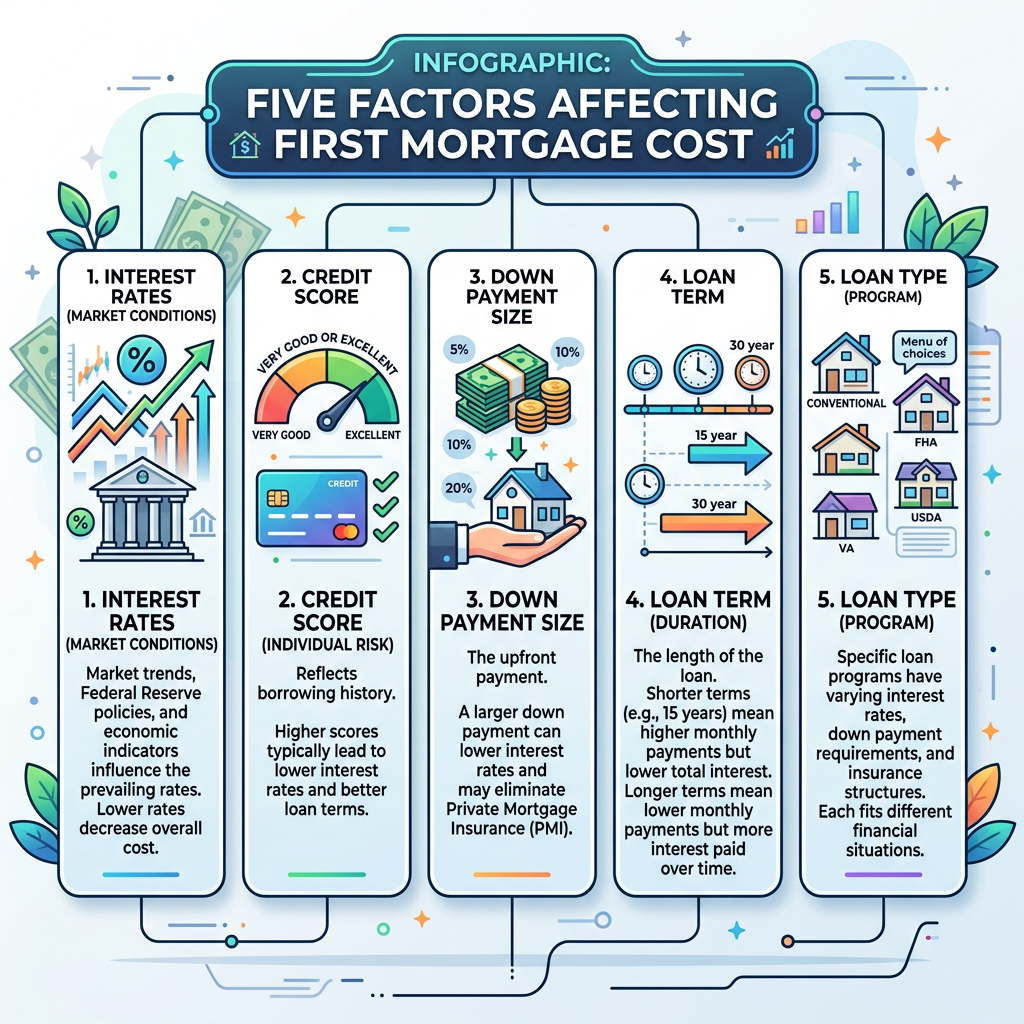
Your first mortgage is likely the largest financial commitment you will ever make, and in Northeast Florida — where home prices in St. Johns County, Duval County, and Flagler County range from $250,000 starter homes to multimillion-dollar oceanfront properties — understanding what drives the cost of your loan can save you tens of thousands of dollars over the life of your mortgage. Danielle Fraser at daniellefraserrealestate.com works with first-time buyers across the First Coast and consistently finds that buyers who understand these five factors enter the mortgage process with far better outcomes.
1. Your Credit Score
This is the single most impactful factor you control before applying. The difference between a 680 and a 760 credit score on a $380,000 loan in today’s market can represent a rate difference of 0.5–0.75%, which translates to roughly $100–$180 more per month and $36,000–$65,000 more in total interest over 30 years. Pull your credit reports from all three bureaus at AnnualCreditReport.com before you start shopping, dispute any errors, and pay down revolving balances to below 30% — ideally below 10% — of each card’s limit before you apply.
2. Your Down Payment
The size of your down payment affects your loan in two primary ways: your loan-to-value ratio (which affects your rate and terms) and whether you pay private mortgage insurance. On a conventional loan, putting less than 20% down triggers PMI, which typically adds $80–$200/month on a $380,000 Northeast Florida home. FHA loans require just 3.5% down but carry their own mortgage insurance premium for the life of the loan unless you put 10%+ down. VA loans (for eligible veterans and military families) require zero down with no PMI. USDA loans also offer zero-down options in designated rural areas, which include parts of western St. Johns County and Flagler County.
3. Your Loan Term
A 15-year mortgage carries a significantly lower interest rate than a 30-year mortgage — often 0.5–0.75% lower. But the monthly payment is substantially higher. For most Northeast Florida first-time buyers, the 30-year fixed loan makes sense because it provides the lowest required monthly payment (allowing financial flexibility), even if you choose to make extra principal payments when your budget allows. The key is not to let the lower required payment become a ceiling — make additional payments to principal whenever possible.
4. The Interest Rate Environment at the Time You Buy
Interest rates are influenced by Federal Reserve policy, inflation, and broader economic conditions — none of which you can control. What you can control is locking your rate at the right time during your purchase process and shopping at least 3 lenders before committing. In Northeast Florida’s current market, rates in the 6–7% range are the baseline. On a $380,000 loan, the difference between 6.25% and 6.75% is approximately $115/month and $41,000 over 30 years — the value of spending a few days comparison-shopping is enormous.
5. Property Taxes and Insurance — The Often-Underestimated Costs
In Florida, property taxes and homeowner’s insurance are typically escrowed into your monthly mortgage payment and have a bigger impact on affordability than most first-time buyers realize. Northeast Florida property taxes vary by county and school district: a $400,000 home in St. Johns County (32081/Nocatee) may carry a tax bill of $4,500–$6,000/year depending on millage rates. Homeowner’s insurance has risen dramatically — budget $2,500–$5,000+/year depending on location, construction type, and flood zone. Always get your insurance quote before making an offer so you can include it accurately in your payment calculation.
Frequently Asked Questions: First Mortgage Costs in Northeast Florida
Should I choose a fixed-rate or adjustable-rate mortgage for my first home in Northeast Florida?
For most first-time buyers planning to stay in their home 7+ years, a 30-year fixed-rate mortgage is the standard recommendation — it provides payment certainty and protection against rate increases. An ARM (adjustable-rate mortgage) makes more sense if you are confident you will sell or refinance within the initial fixed period (typically 5–7 years).
What is the difference between being pre-qualified and pre-approved for a mortgage?
Pre-qualification is a lender’s estimate based on information you self-report. Pre-approval is a verified assessment based on submitted documentation — pay stubs, tax returns, bank statements, and a hard credit pull. In Northeast Florida’s market, sellers expect pre-approval letters, not pre-qualifications. Get pre-approved before you start making offers.
How much house can I actually afford as a first-time buyer in Northeast Florida?
A common guideline is to keep your total monthly housing costs (mortgage, taxes, insurance, HOA) below 28–30% of your gross monthly income. On a $90,000 household income, that is roughly $2,100–$2,250/month in housing costs. In today’s Northeast Florida market, this typically aligns with a purchase price in the $270,000–$320,000 range with a 5–10% down payment.
Key Takeaway
Your first mortgage in Northeast Florida is shaped by factors you partly control (credit, down payment, lender choice) and partly do not (rates, property taxes). Understanding all five lets you optimize what you can and plan accurately for what you cannot. Danielle Fraser can connect you with trusted local lenders who will give you clear, honest guidance from your first consultation.
Contact Danielle Fraser, P.A. today:
📞 (904) 907-4559
📧 danielle@daniellefraserrealestate.com
🌐 daniellefraserrealestate.com