
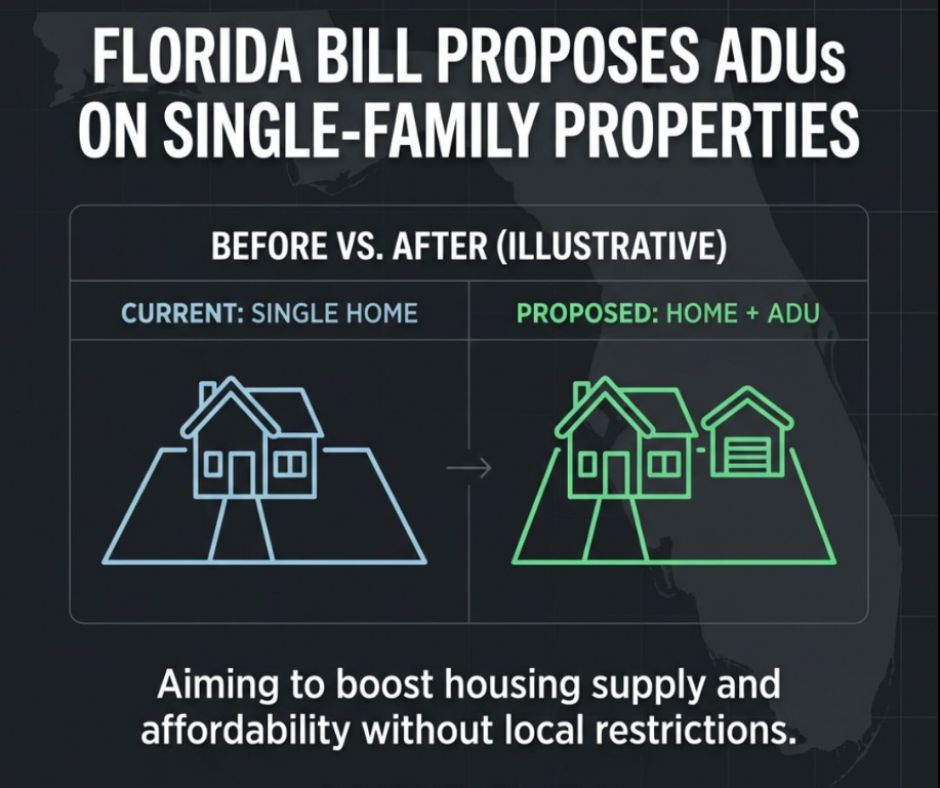
Florida is considering legislation that could require cities and counties to allow accessory dwelling units — ADUs — on single-family properties statewide. For homeowners, buyers, and investors in Northeast Florida across St. Johns County, Duval County, and Flagler County, this proposal has meaningful implications for property value, rental income potential, and housing supply. Danielle Fraser at daniellefraserrealestate.com monitors Florida housing legislation that affects property owners from Nocatee (32081) to St. Augustine (32084) to Palm Coast (32137) — here is what the ADU proposal means for you.
What Are Accessory Dwelling Units and What Is Florida Proposing?
Accessory dwelling units — commonly called ADUs, in-law suites, granny flats, or casitas — are secondary housing units built on the same lot as a primary single-family home. They can be attached to the main house (a converted garage or basement apartment) or detached (a separate cottage in the backyard). They range from efficiency studios to full two-bedroom apartments.
Florida’s proposed legislation would require municipalities across the state to permit ADUs on single-family residential lots, overriding local zoning restrictions that currently prevent or heavily restrict their construction in many jurisdictions. The bill is designed to address Florida’s significant housing supply shortage — estimated at over 120,000 units statewide including more than 55,000 single-family homes — by unlocking ADU construction on existing residential lots without requiring new land development.
Key features of the proposal include preventing local governments from imposing special approvals, design standards that exceed the primary structure requirements, additional parking mandates, or residency requirements that restrict who can occupy the ADU. The legislation also aims to protect homestead tax exemptions for property owners who add ADUs, and would protect the homestead exemption from being affected by the presence of a rental ADU.
What Would ADU Legalization Mean for Northeast Florida Homeowners?
For homeowners in Northeast Florida — particularly those with larger lots in established communities in Duval County, older St. Johns County neighborhoods, or Palm Coast’s spacious suburban footprint — ADU legalization creates several meaningful opportunities.
Rental income. A well-built ADU can generate $1,200 to $2,000 per month in rent in most Northeast Florida markets, providing a meaningful income stream that can offset mortgage payments, fund retirement, or support aging parents who want to live nearby with independence. Near NAS Jacksonville, ADU rentals serving military families could command premium rents given consistent demand.
Multi-generational living. ADUs are ideal for housing aging parents or adult children who want proximity but independence. In Northeast Florida’s growing retirement destination communities — St. Augustine, Ponte Vedra Beach, Palm Coast — ADUs enable the multi-generational living arrangements that many families are actively seeking.
Property value. Well-designed ADUs on properties in desirable school zones and established communities add measurable value. A legal, permitted ADU with rental income history can significantly increase a property’s appraised value and buyer appeal at resale.
Short-term rentals. An important distinction: the Senate version of the proposed legislation allows local governments to maintain restrictions on short-term rentals from ADUs, while the House version does not. This matters significantly for Northeast Florida’s beach communities and tourist areas. Whether ADU short-term rentals would be permitted in Atlantic Beach, St. Augustine Beach, or Flagler Beach depends on which version of the legislation ultimately passes.
What Should Northeast Florida Buyers Know About ADUs?
If this legislation passes, it would immediately expand the potential of many single-family properties in Northeast Florida. Buyers evaluating homes with large lots, detached garages, or space for rear-yard construction should consider ADU potential as part of their value analysis. A property that currently cannot legally have an ADU under local zoning rules may be able to accommodate one if statewide legislation overrides those restrictions.
Buyers should also be aware that ADU legislation will take time to implement even if passed, and local jurisdictions may seek to apply the narrowest possible interpretation. Working with an agent who understands the evolving regulatory landscape is important for buyers making decisions based on ADU potential.
Frequently Asked Questions: ADUs and Northeast Florida Real Estate
Are ADUs currently allowed in St. Johns County or Jacksonville?
ADU regulations vary by municipality and county in Northeast Florida. Some jurisdictions allow ADUs with specific conditions; others prohibit or heavily restrict them. The proposed state legislation would override local restrictions that exceed what the state law permits. Danielle Fraser can provide current guidance on ADU regulations for specific properties and communities.
How much does it cost to build an ADU in Florida?
ADU construction costs in Florida typically range from $80,000 to $200,000+ depending on size, finishes, and whether the unit is attached or detached. Permitting, site preparation, and utility connections add to the total. Financing options include home equity loans, HELOCs, and construction loans. The return on investment depends on local rental rates and the specific community.
Would an ADU affect my homestead exemption in Florida?
The proposed legislation specifically includes provisions to protect homestead tax exemptions for primary homeowners who add ADUs. This is a significant feature, as losing the homestead exemption would substantially increase property taxes. Consult a real estate attorney or CPA for guidance specific to your situation once the final legislation is enacted.
Key Takeaway
Florida’s ADU legislation — if passed — would meaningfully expand the income, flexibility, and value potential of single-family properties across Northeast Florida. For homeowners considering adding an ADU, buyers evaluating properties with ADU potential, and investors building long-term residential portfolios, this legislative development is worth monitoring closely. Danielle Fraser tracks Florida housing legislation and its implications for Northeast Florida property owners and buyers.
Contact Danielle Fraser, P.A. today:
📞 (904) 907-4559
📧 danielle@daniellefraserrealestate.com
🌐 daniellefraserrealestate.com