
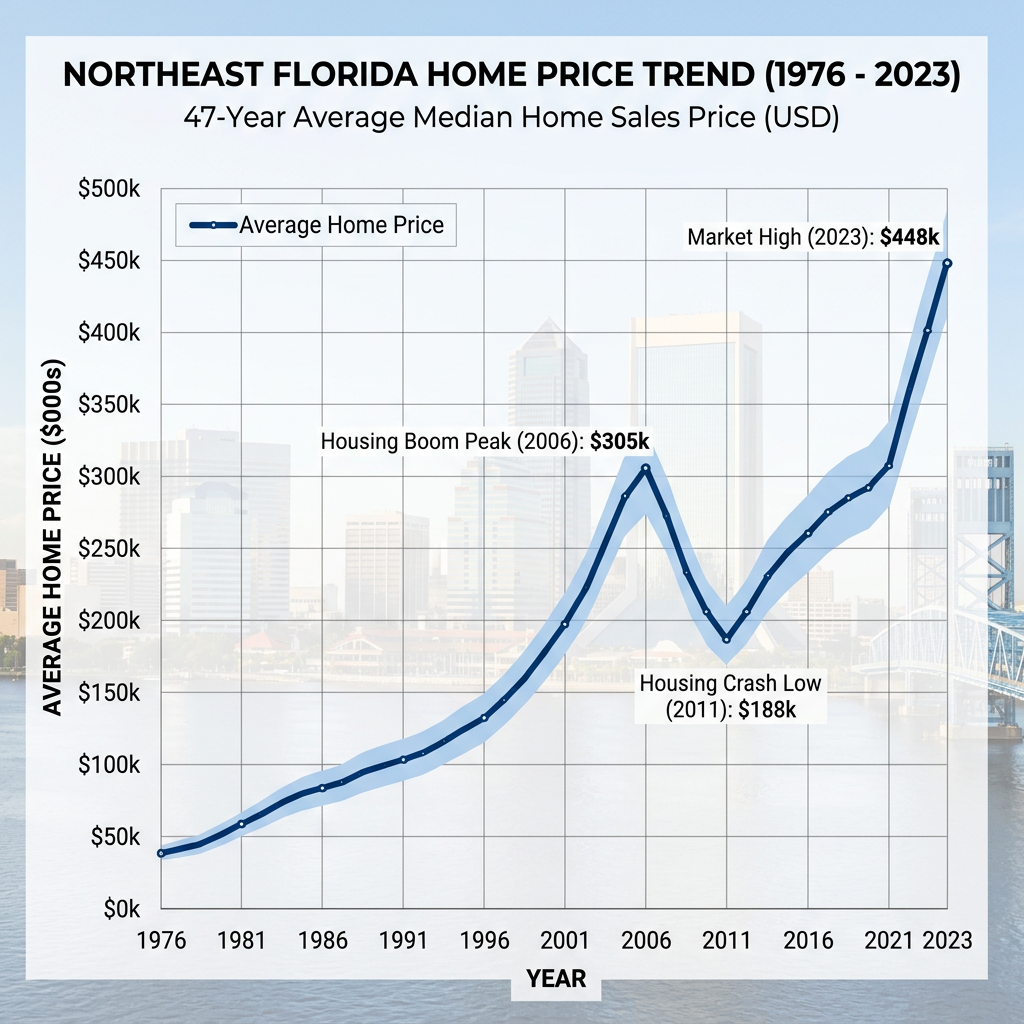
Should you buy a home in Northeast Florida right now — or wait? It is one of the most common questions Danielle Fraser at daniellefraserrealestate.com hears from buyers sitting on the fence in St. Johns County, Duval County, and Flagler County. The answer, backed by nearly 50 years of real price data for the Northeast Florida market, is more reassuring than most buyers expect: in 42 out of 47 years since 1978, home prices in Northeast Florida were higher than the year before. The data does not eliminate risk — but it puts that risk in accurate, honest perspective.
What Have Northeast Florida Home Prices Done Over 47 Years?
The Market Distillery, a financial analysis resource founded by Dr. Alex Stewart — a former financial analyst, mortgage banker, and university professor — has published a data-driven home buying guide specifically for the Northeast Florida market using FHFA House Price Index data going back to 1978, covering Duval, St. Johns, Clay, Nassau, and Baker Counties.
The headline finding is striking: in 42 out of 47 years, Northeast Florida home prices ended the year higher than they started. That is not a sales pitch. That is what the actual price index data shows across nearly five decades of market cycles, recessions, rate spikes, and geopolitical events.
For buyers in Nocatee (32081), St. Augustine (32084), Ponte Vedra Beach, Jacksonville, and Palm Coast (32137) who are wondering whether this is a reasonable time to buy, the long-run data provides meaningful context that short-term market commentary rarely offers.
You can explore the full interactive data, run your own scenario with a home price calculator, and see the worst, average, and best historical outcomes for any ownership timeline at: The Market Distillery — Buying By the Numbers: Northeast Florida
What Does the Data Show About Ownership Timeline?
The single most important variable in Northeast Florida real estate is not what rates are doing or where prices are today — it is how long you plan to stay. The Market Distillery data makes this point with compelling specificity:
Over every historical 1-year window since 1978, prices were higher at the end than the start 42 out of 47 times (89%) in Northeast Florida. Over 3-year windows, prices were higher 40 out of 45 times (89%). Over 5-year windows, 38 out of 43 times (88%). Over 10-year windows, 35 out of 38 times (92%). And over every single 15-year window in the data — all 33 of them — prices were higher 100% of the time.
For a buyer in Nocatee planning to stay 7+ years, or a retiree purchasing in St. Augustine’s 32084 historic district or on Anastasia Island planning to hold long-term, these odds are about as favorable as any asset class delivers over comparable time horizons.
What About 2008 — Isn’t That What Could Happen Again?
The 2008 housing crash is the legitimate concern every honest buyer raises — and the Market Distillery addresses it directly rather than dismissing it. Northeast Florida prices fell for five consecutive years during the crash, dropping approximately 35% from the 2006 peak before bottoming in 2012. Buyers who purchased at the peak and were forced to sell during the decline took real losses. Buyers who held through it did not recover to 2006 price levels until 2019 — a 13-year wait.
What made 2008 categorically different from every other recession in the data set is that real estate was the cause of the crash, not a casualty of it. Millions of homeowners had been placed into adjustable-rate mortgage products they could not sustain when rates reset. They had little or no equity. When those loans reset, forced selling cascaded through the market at scale. That is the specific mechanism that drives significant price declines — mass forced selling with no equity buffer.
That mechanism is significantly harder to repeat today for two concrete reasons. First, lending standards are materially tighter than 2006 — the exotic mortgage products that drove the crisis no longer exist in the mainstream market. Second, and critically: 44% of Florida homeowners currently own their home free and clear with no mortgage at all, according to the U.S. Census Bureau. When nearly half of all owners have zero debt on their home, the kind of forced-selling cascade that defined 2008 requires conditions that are not present in today’s market.
The Real Risk: A Short Hold, Not a Market Crash
The Market Distillery makes a point that Danielle Fraser reinforces in every buyer consultation: the bigger risk for most buyers is not a market crash — it is buying with a timeline that is too short to absorb transaction costs.
Selling a home in Northeast Florida typically costs 6 to 8% of the sale price in agent commissions, closing fees, and related costs. Even if prices rise modestly, a hold of less than 2 to 3 years can result in a net loss once transaction costs are factored in. The risk is not always that prices fall — sometimes it is that they do not rise fast enough to cover the cost of selling.
This is the most important pre-purchase conversation to have. If there is a genuine possibility you would need to move within 3 years — due to job change, family circumstances, relocation, or anything else — that needs to be on the table before you buy, not after. Danielle Fraser has this conversation with every buyer she works with, without exception.
Why Do Northeast Florida Home Values Rise Over Time?
The Market Distillery identifies the structural forces that drive long-run appreciation in Northeast Florida, and they are not abstract — they are specific and ongoing:
Population growth. Jacksonville is one of Florida’s fastest-growing metros. More people competing for the same homes creates consistent upward price pressure that does not disappear in a single slow quarter.
A diversified, anchored job market. Northeast Florida’s employer base — Mayo Clinic, Baptist Health, Fidelity Investments, Fanatics, VyStar Credit Union, plus military at NAS Jacksonville and a growing logistics and technology sector — creates sustained housing demand from qualified buyers across income levels.
Supply constraints. Building new homes takes years and significant capital. In Northeast Florida, coastal proximity, infrastructure capacity, and permitting timelines limit how quickly new supply can respond to demand. Existing homes become more valuable when demand outpaces the construction pipeline.
No state income tax. Florida’s zero state income tax continues to attract buyers from California, New York, Illinois, and other high-tax states. That migration inflow supports demand independent of local economic conditions.
Inflation and real asset value. A home is a real asset. When the cost of lumber, land, and labor rises, building new homes costs more. That makes existing homes worth more. Over time, real assets have historically held value against a depreciating dollar.
How to Use the Market Distillery Calculator for Your Specific Situation
The most useful feature of the Market Distillery’s Northeast Florida page is the interactive home value calculator. You enter a purchase price and planned ownership timeline, and it shows you three scenarios drawn from actual historical FHFA data for the Northeast Florida market:
Worst historical case: based on buyers who purchased right before the 2008 crash and sold at the bottom — the actual worst outcome in 47 years of data.
Average historical case: the typical outcome across all historical windows matching your timeline.
Best historical case: the strongest run in the data for your ownership period.
The calculator also shows the percentage of historical periods in which prices were higher at the end of your chosen ownership window than at the start. This gives buyers a genuine, data-grounded frame of reference rather than a speculative projection.
Use it as a starting point, then bring the scenario to Danielle Fraser to discuss how it applies to the specific community, price point, and property type you are considering in Northeast Florida.
Access the full interactive guide and calculator here:
🔗 themarketdistillery.com/buying-by-the-numbers-northeast-florida
Frequently Asked Questions: Buying a Home in Northeast Florida by the Numbers
Is now a good time to buy a home in Northeast Florida?
The data suggests that buyers who plan to stay at least 5 years have historically favorable odds in Northeast Florida — 88% of all 5-year windows since 1978 showed higher prices at the end than the start. The more important question than market timing is your personal timeline, financial stability, and whether your monthly payment is sustainable at a fixed rate. If those conditions are met, the 47-year data is encouraging.
What if prices fall right after I buy in St. Johns County or Jacksonville?
The critical variable is whether you would be forced to sell during a decline. Buyers with fixed-rate mortgages, stable income, meaningful equity, and a 5+ year plan have historically been able to hold through price corrections and recover. The buyers who lost money in 2008 were overwhelmingly those who had to sell during the decline — not those who held through it.
How does Northeast Florida compare to national home price trends?
Jacksonville has generally matched or outperformed national appreciation averages over the long run, with strong population growth, coastal lifestyle appeal, no state income tax, and a diversified employer base providing sustained demand drivers. The 2008 crash hit harder here than in some markets, but the recovery since the 2012 bottom has been strong, with prices roughly tripling from the trough.
Key Takeaway
Forty-seven years of Northeast Florida home price data offers buyers on the fence the clearest possible answer: most buyers who stayed long enough came out ahead, and the odds improved significantly the longer they held. The risk is real but specific — it lives primarily in short holds, forced sales, and over-leveraged purchases, not in the long-run direction of Northeast Florida home values.
Danielle Fraser uses data like this in every buyer conversation — not to pressure anyone into purchasing, but to make sure every buyer she works with understands the real numbers behind the decision they are making. If you are on the fence about buying in St. Johns County, Duval County, or Flagler County, start with the Market Distillery calculator, then call Danielle to talk through what the numbers mean for your specific situation.
Contact Danielle Fraser, P.A. today:
📞 (904) 907-4559
📧 danielle@daniellefraserrealestate.com
🌐 daniellefraserrealestate.com