
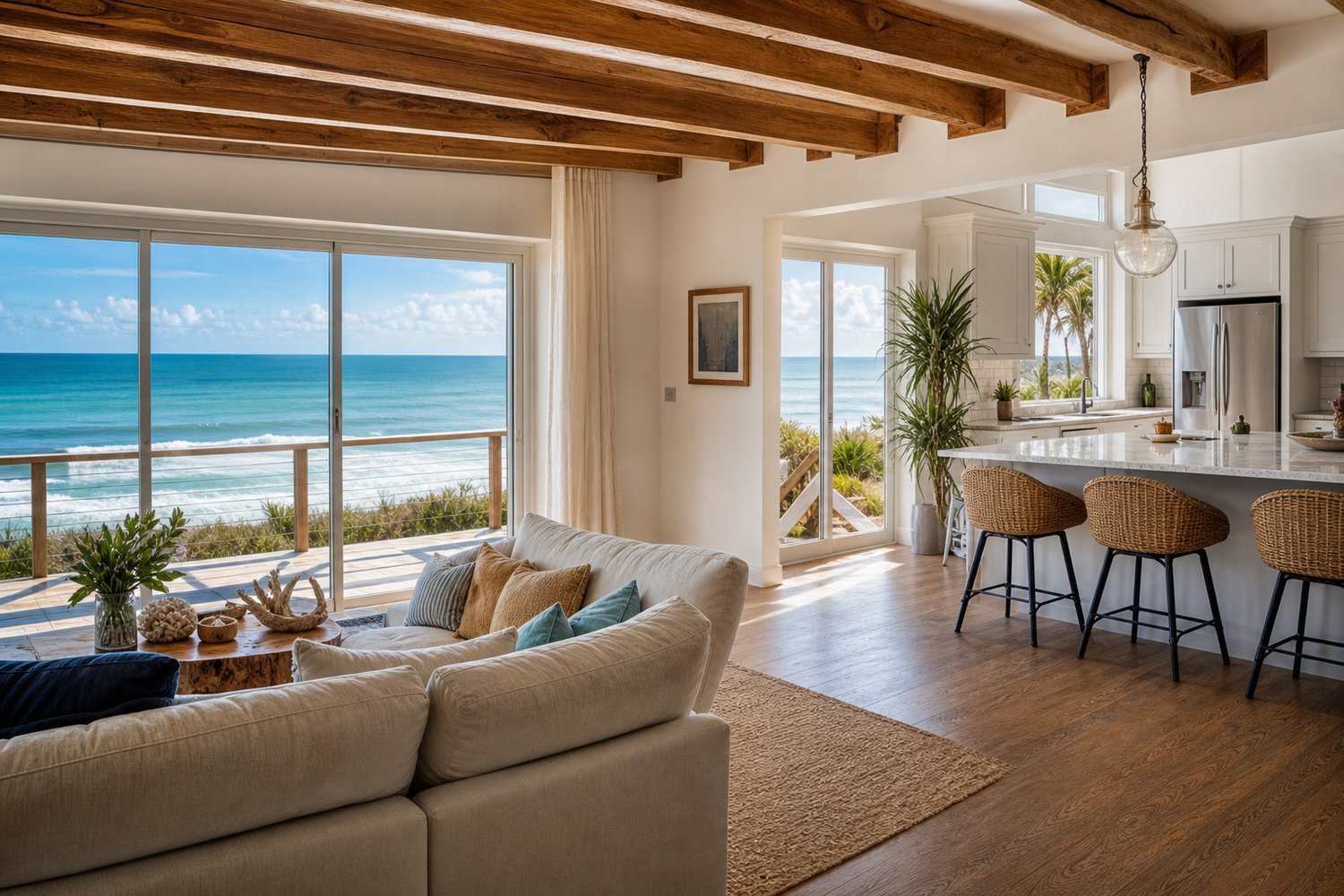
Before you fall for a Flagler Beach oceanfront listing, confirm four things for that exact address: the FEMA flood zone, written insurance indications, the condition of the building’s exterior, and what the condo or HOA documents and the city allow for rentals. Do it during your contract period, not after closing.
What does oceanfront living beyond the view mean for a Flagler Beach second home?
Oceanfront living beyond the view means judging a Flagler Beach property by what it costs to insure, maintain, and legally use, not just by what you see from the balcony. Flood exposure, wind and flood insurance availability, salt-air wear, and condo or HOA rental limits can change both your carrying cost and how often you can use or rent the home. Confirm each one for the exact address before you commit.
Key Takeaways
- Northeast Florida recorded 6,531 active homes in October 2026, up from 6,287 in September, with a regional single-family median of $399,056, but that is regional context and not a price for Flagler Beach oceanfront.
- Flood insurance normally has a 30-day waiting period before coverage takes effect, so quotes and coverage timing belong early in your contract period.
- Standard homeowners policies generally do not cover flood damage, and flood status is set parcel by parcel, not by how close the home sits to the sand.
- For a condo, the declaration, rules, budget, and assessment history control whether you can rent it, not the listing description.
- Photos cannot show orientation, salt exposure, noise, or whether the ocean view is obstructed, so walk the property in person.
How do flood zones and insurance change the cost of owning oceanfront in Flagler Beach?
They can change it more than almost any other factor, because flood coverage is separate from your homeowners policy and your flood zone is determined by the specific parcel. Flagler County states that ordinary homeowners policies generally do not cover flood damage, and that federally backed mortgages require flood insurance when a property is in a designated high-risk area.
I walk my second-home buyers through this before they get attached to a floor plan. A beautiful unit you can’t insure at a workable price is the wrong purchase, however good the sunrise looks.
Is the FEMA flood zone the same as a hurricane evacuation zone?
No. They are two different systems that answer two different questions. A FEMA flood zone drives flood insurance requirements and rates. An evacuation zone is an emergency-management designation that tells you when to leave during a storm. Knowing one does not tell you the other, so check both for the address, and confirm the evacuation zone with the county’s emergency management office.
How do I confirm the flood zone for a specific address?
Use the parcel record and the FEMA flood maps for that address. Flagler County directs owners to FEMA’s Flood Insurance Rate Maps and recommends confirming the zone and base-flood information with the county floodplain manager or an insurance professional. Maps can change, so don’t rely on a neighbor’s zone or a guess based on distance from the beach.
Should you get an insurance quote before making an offer?
Yes, get written indications as early as you can, at minimum before your inspection deadline. Flagler County’s Flood Smart guidance notes that flood insurance normally carries a 30-day waiting period, with policy-specific exceptions. That timing matters if you plan to close quickly or want coverage in place before a storm.
Ask your insurance agent for indications on each of these:
- The structure and your contents
- Wind coverage and flood coverage
- Liability and, for a condo, loss assessment coverage
- Any required deductibles, which can be separate for wind and flood
For a condominium, find out whether the association’s master policy covers only common elements or also parts of the unit interior, and what the owner is responsible for. If you’re paying cash, no lender will require flood coverage, but the exposure is the same. Your numbers depend on the building, the elevation, and your coverage choices, which is why I’d rather you hear them from an insurance professional than from a blog.
What should you inspect in person at an oceanfront property?
Inspect the exterior, the structure, and the exposure, not just the interior finishes. A coastal inspection should cover the roof, building envelope, corrosion, drainage, and elevation, plus any seawall or bulkhead where one applies. I’m firm on one point: never choose a coastal home based solely on photographs. They can’t show you what the building has been through or what the exposure feels like day to day.
Why does location and orientation matter so much?
Because photos flatten everything. Standing on the property, confirm which way the rooms, balconies, pool, mechanical equipment, and entrances face: the ocean, the dunes, the street, or a neighboring building. Then check:
- Whether the “ocean view” is real, seasonal, or partly obstructed
- Walking distance and path to the beach
- Salt spray, prevailing-weather exposure, and noise
- Parking and guest access
- Your storm evacuation route
Views and location are the two things you can’t renovate later, so test them while you still have leverage in the contract.
How much more maintenance does salt air create?
More than an inland home, and the wear shows up in specific places. There is no universal repair figure worth quoting, because it depends on the building’s age, materials, and past upkeep. A qualified inspector and your insurance quote give you real answers. During your walk-through, look closely at:
- Roof coverings, fasteners, and flashing
- Windows and doors, and signs of wind-driven rain
- Balcony attachments and deck hardware
- Stucco or siding and exterior paint
- Exposed concrete and reinforcing steel
- HVAC equipment, electrical components, and plumbing fixtures
What does a coastal due-diligence checklist look like?
| What to confirm | Where to check it | Why it matters |
|---|---|---|
| FEMA flood zone | Flagler County resources and FEMA flood maps for the exact address | Drives flood insurance requirements and exposure |
| Wind and flood insurance | Written indications from an insurance agent | Determines whether the property is insurable and what coverage looks like |
| Roof and building envelope | Licensed inspector, plus specialists as needed | Salt and wind-driven rain show up here first |
| Seawall, bulkhead, drainage | Specialized evaluation where applicable | Protects the lot and affects long-term upkeep |
| Permits for coastal work | City or county permitting records | Material work should be properly permitted |
| Association records | Declaration, rules, budget, minutes, assessments | Shows financial health and use restrictions |
| Rental eligibility | City or county rules plus governing documents | Decides whether the home can earn income |
A practical sequence is to get insurance indications first, review the flood and evacuation maps, run a full inspection during the contract period, order any specialized roof, structural, seawall, or moisture evaluations, then review the association records. Confirm rental eligibility before your inspection or other contractual deadlines expire.
Can you rent a Flagler Beach oceanfront condo or home short term?
It depends on two layers you must verify in writing: the local rules for that address and the governing documents of the building or HOA. Don’t assume a listing’s rental-friendly language is accurate. The documents control permitted use, not the marketing copy.
Does the address sit in the City of Flagler Beach or elsewhere in Flagler County?
Check this first. Zoning, permitting, evacuation information, and enforcement can differ by jurisdiction. Confirm the address, then confirm directly with the City of Flagler Beach or the county, whichever applies, what is required for short-term rental. That includes zoning permission, business or vacation-rental licensing, occupancy limits, parking, trash, noise, and tax obligations. I don’t rely on secondhand summaries for this. Verifying short-term-rental regulations at the source protects you from buying a property you can’t use the way you planned.
What rental restrictions should you look for in condo or HOA documents?
Request the full document package before you’re deep into the contract:
- Declaration, bylaws, and rules
- Current budget and any current or proposed assessments
- Insurance information and meeting minutes
- Rental restrictions and minimum lease terms
- Pet and parking rules and architectural standards
- Any storm-repair obligations
Minutes are often where you learn about repairs the association is debating or assessments that are coming. That affects your carrying cost as much as the purchase price does. If you want to compare how oceanfront condo ownership works elsewhere on the coast, my Jacksonville Beach oceanfront condo guide covers a similar set of questions.
How does Northeast Florida’s market fit into a Flagler Beach purchase?
It gives you context, not a price. In October 2026, the Jacksonville metropolitan market was reported at 66 median days on market, with active listings down 10.9% year over year, according to Realtor.com. Across the broader region, News4JAX reported 6,531 active homes in October, up from 6,287 in September, with a regional single-family median of $399,056.
Those are metro and regional figures. They don’t establish the value, liquidity, insurance burden, or rental performance of a Flagler Beach oceanfront property. Within the same stretch of coast, elevation, building type, association finances, and insurability can produce very different outcomes. That is why a property-specific analysis matters more than a headline number.
Weigh each purchase as both a place to enjoy and an asset, and think about how you’ll use it over time. If you’re comparing coastal options across the region, my guides to oceanfront living in St. Johns County and to downsizing in Flagler Beach add useful context.
Want to see what other clients say about working with me? Read my reviews on Google and Zillow.
FAQ
Is an oceanfront home in Flagler Beach required to carry flood insurance?
It is required if the property is in a designated high-risk flood area and you use a federally backed mortgage. Flagler County also notes that ordinary homeowners policies generally don’t cover flood damage. Cash buyers face no lender requirement, but the flood exposure is the same, so confirm the parcel’s FEMA zone before you decide.
What is the difference between a FEMA flood zone and a hurricane evacuation zone?
A FEMA flood zone relates to flood insurance risk and requirements, while an evacuation zone tells you when to leave ahead of a storm. They are separate designations, so one doesn’t predict the other. Check both for the exact address.
Can I use a Flagler Beach condo as a short-term rental?
Only if both the local rules and the building’s governing documents allow it. Confirm in writing with the City of Flagler Beach or the county, depending on the address, and review the declaration, rules, and any minimum lease terms. Do this before your contract deadlines expire.
How much more maintenance does salt air create for an oceanfront second home?
Expect more wear on exterior and mechanical components than at an inland home, though the amount depends on the building’s age, materials, and upkeep. Roofs, windows, balcony hardware, exposed concrete, HVAC equipment, and paint are the usual places to look. An inspection tells you far more than a general estimate.
Should I get an insurance quote before making an offer on an oceanfront second home?
Yes, get written indications as early as possible. Flood insurance normally has a 30-day waiting period, and wind, flood, roof, and condo coverage all interact. Knowing the outcome early keeps you from discovering an insurability problem after you’ve committed.
The core point of oceanfront living beyond the view is that the right home is the one you can insure, maintain, and use the way you plan to. If you’re weighing a Flagler Beach oceanfront home or condo as a second home, I’ll help you run those checks on the specific property and think two steps ahead of the contract deadlines. Schedule a consultation: danielle@daniellefraserrealestate.com | (904) 907-4559. You can also search listings here.
Equal Housing Opportunity. Danielle Fraser, Sales Associate | FREC, regulated by the Florida Real Estate Commission (FREC). Listing information is deemed reliable but not guaranteed; MLS data is provided for general reference only. This article is general information, not legal, tax, or financial advice. Confirm your own numbers with your title company, tax advisor, insurance professional, or lender.